




Full video in Kinyarwanda; Our insights in English.
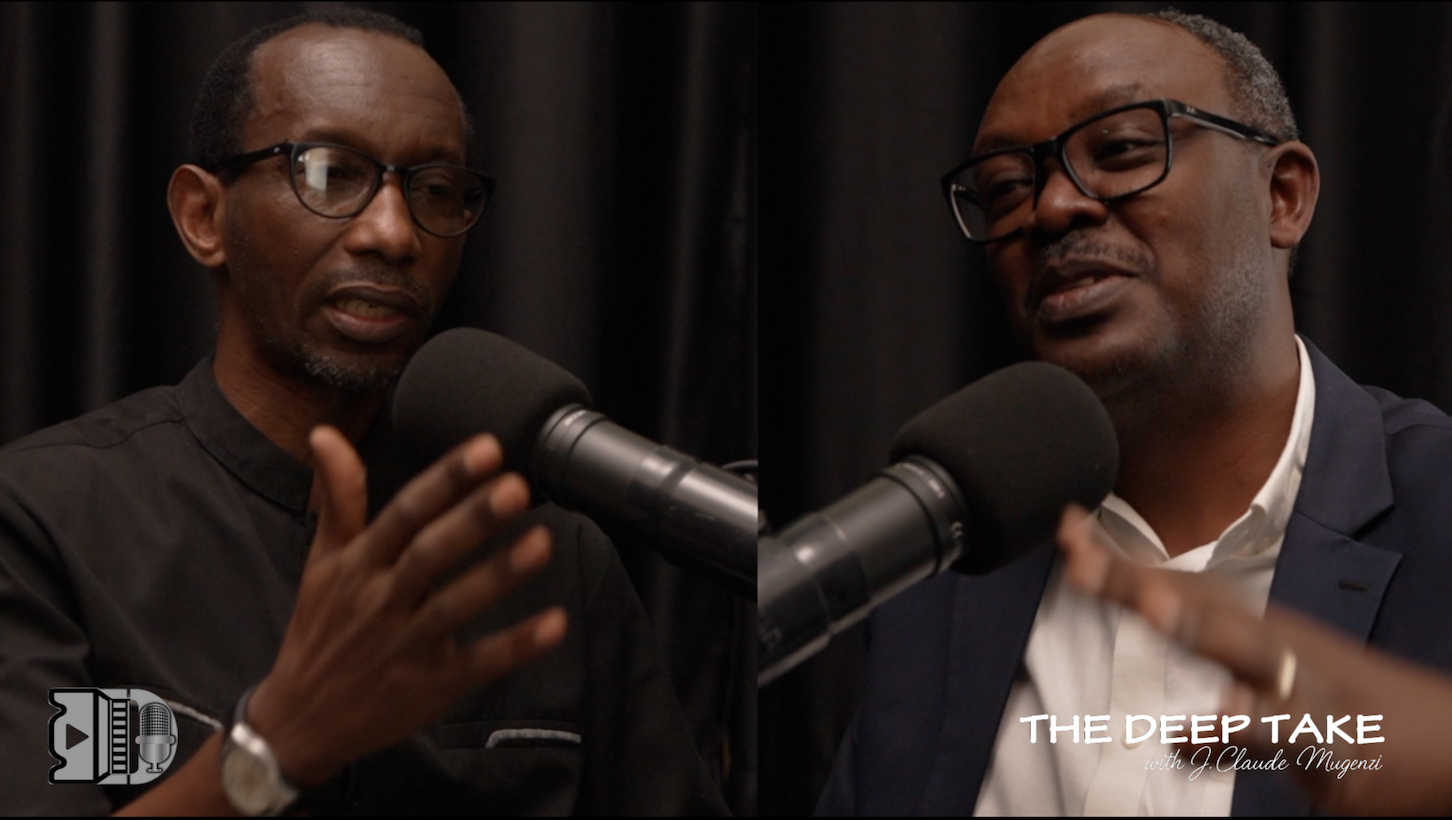
Kwibuka is not simply about keeping history alive; it’s about what a society chooses to do with its history, as it decides how it moves forward. Over the last 32 years, Rwanda’s approach to remembering the Genocide against the Tutsi has evolved — in language, institutions, research, testimony, justice, commemoration and, increasingly, in the question of what remembering is supposed to make possible. Rwanda’s progress in that regard, in addition to a reflection about persisting challenges, is part of this conversation with Philibert Gakwenzire, PhD, historian, genocide scholar, and president of IBUKA genocide survivors’ association.
Kwibuka Twiyubaka — remember, rebuild. These words do matter. Because memory can become a burden if it leaves a society trapped in grief, guilt or fear. But it can also become a foundation — for rebuilding physically, socially and emotionally, and for understanding who we are, beyond what happened to us. And perhaps this is where history, testimony, culture and imagination meet: A survivor carries a testimony; a historian carries a responsibility to examine; an artist carries the power to imagine; a society carries the responsibility to listen … and none of these perspectives is sufficient alone.
The story of Rwanda has also been shaped by powerful images of what we believed Rwanda was — and could become, despite cycles of violence that the country had experienced. For generations, even those who had never been expelled from the country carried a Rwanda of their dreams with them: the country of milk and honey. That imagination helped keep that flame alive and was transmitted to a younger generation, that, ultimately liberated the motherland.
If we focus only on those cycles, we risk missing another remarkable part of the story: the capacity to bounce back and rebuild. As Philibert Gakwenzire, PhD rightly puts it ‘Rwanda’s roots go very very deep’. He adds an eloquent metaphor of a giant that might suffer from a deep wound or jitters .. It does not mean the giant is inherently bad; the wound can heal.
Perhaps the deeper challenge is therefore not only how we remember what happened, but how we help those who did not live through it build an identity that is larger than the trauma. For the younger generation, memory cannot rest forever on fear or inherited guilt. They need roots, they need history, but also culture, beauty, imagination and a sense that Rwanda belongs to them — not simply as the place where terrible things happened, but as a country with a much longer and richer story.
And this raises difficult questions … Can we examine our history honestly without abandoning our identity? Can a historian take sufficient distance from his or her own inherited identity? How does testimony and historical analysis coexist ? How do wrap our heads around the notion of ‘Tutsi, Hutu, Twa’ without being divisive and a hindrance to social cohesion? And can a society deconstruct the ideas that once divided it without pretending that those divisions never existed? Perhaps that is part of the work of memory itself … not forgetting … not denying.
True to his researcher fiber, Gakwenzire compares the overblowing of the ‘ethnic’ factor in the post-independence and pre-genocide Rwandan society, to a ‘mental’ laboratory, with huge amounts of ‘chemical fertilizers … you very easily amplify one element and get exponential results! With ethnicity in Rwanda, it did not have to be scientific, sociologic … ideology was enough to blow it up. ‘But political will and direction has decided to put an end to that [‘ethnicisation’ of society]. Another conversation worth having in-depth is what about those still determined to make it the foundation of their understanding of the same society. ‘Vigilence’ he clarifies.
But taking enough distance from the past to understand how it shaped us — and enough courage to decide what we carry forward. Because justice, trials, Gacaca, testimony, scholarship, books, art and commemoration do more than preserve what happened. They can help a society move through it. It was very interesting to hear Gakwenzire connect memory, trials [even in Europe], to reconciliation. ‘Even their jury members get enlightened by commemoration activites in their own countries’ he said. Those activites have indeed placed Rwanda’s experience within a wider human story — and contributed to international awareness, justice and historical record.
But memory is fragile; people forget; and history could be rewritten. The conversation took us to the situation prevailing in the DRC, with armed groups determined to carry on their genocidal plans, often with support from governments. One of Gakwenzire’s metaphors once again horrified me … ’masons use the heaviest hammer to crash the most solid rock’ … adding that it happened to Armenia, Israel and Rwanda. No polemics … but one could wonder why so powerful people would gang up against these ‘little’ nations. Do they do that to avoid feeling guilty … is their fight one that seeks to ‘normalize’ their crimes …
Well, if you listen carefully to the conversation with Philibert Gakwenzire, there is no doubt that you will feel a nation determined to deal with its history head on, learn from it and get inspired by what best it has, and move forward.
Thank you.


