



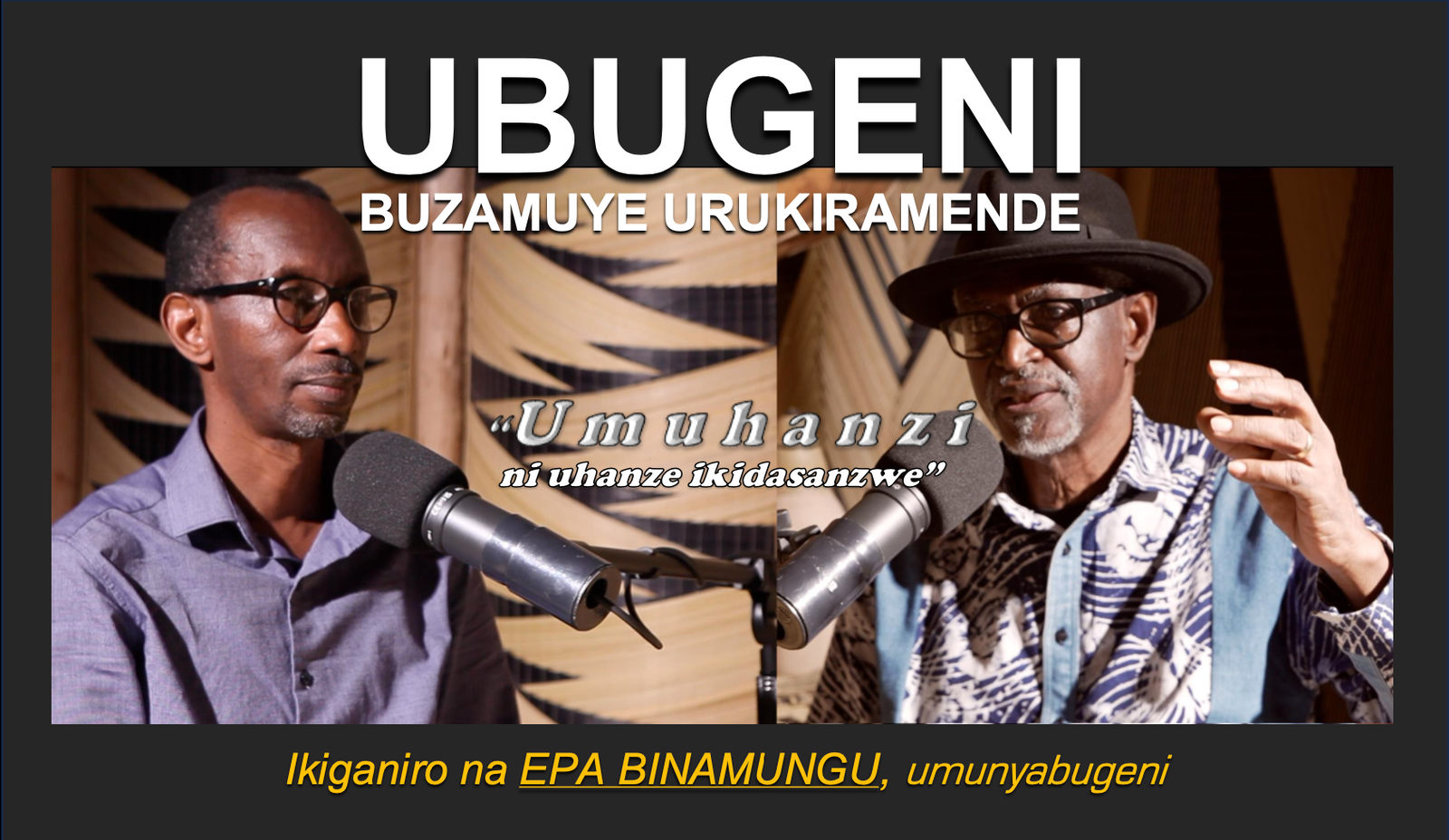

TRUE ARTISTS COMPETE WITH THEMSELVES
“When you create, you are competing against yourself.” It sounds, at first, like a statement about artistic ambition. But listening to Epaphrodite Binamungu, I began to hear something larger in it: the discipline of refusing to let yesterday’s work become tomorrow’s ceiling. Because perhaps the first thing to understand about art is that there is no single way of seeing it.
An artist may create a work with a very clear meaning in mind. Yet once that work leaves the artist’s hands, it enters other people’s worlds. Each viewer brings a different history, memory, education, emotion and set of expectations. The same painting can provoke excitement in one person, indifference in another, and even discomfort or anger in someone else.
That is not necessarily a failure of art. It may be one of the things that makes art art. Binamungu’s own approach begins somewhere quite personal. He creates first as a Rwandan, speaking to Rwandans. Others may enter through the same door and discover something that speaks to them. His work does not begin with an obligation to explain Rwanda to the outside world. It begins at home. And perhaps that is why his observation about learning to “read” art is so important.
We learn to read letters into words, words into sentences. We learn where a sentence breathes, where it pauses and where it ends. Art, too, has a grammar. Every medium has its own language, and understanding a work requires more than simply looking at its surface.
This matters because we often expect art to explain itself immediately. But a work may contain several layers of meaning. What an artist intended is one layer. What a viewer sees is another. What that viewer brings from his or her own life is another. The encounter between the work and the viewer can therefore produce something the artist did not consciously put there. And that encounter can be joyful. It can also be unsettling.
Binamungu describes inspiration almost as something that comes looking for you. It may arrive in the middle of the night, while travelling, or at an otherwise inconvenient moment. When it comes, you have to respond. Write it down. Capture it. Because inspiration can be fleeting. But having an idea is only the beginning. The artist then has to turn that impulse into something tangible – and something that can survive another person’s interpretation.
That is where the vulnerability of art begins. An artist puts part of himself into a work, and then has to accept that other people may misunderstand it, reject it, reinterpret it or see something entirely different. Yet the artist cannot demand that everyone see exactly what he sees. Perhaps the better question is not whether everyone understands the work in the same way, but whether the work gives people enough to enter it.
Binamungu also understands that art has another language: value. There is something different between someone looking at your work and saying, “Wow,” and someone actually buying it and taking it home. The first is appreciation. The second is a form of commitment. When someone buys a work of art, the work crosses a boundary. It leaves the artist’s imagination and enters another person’s life. It acquires another context, another meaning, another history.
That brings us to the old suspicion surrounding art: that drawing is something children do when they should be doing something more serious; that an artist cannot make a respectable living; that art is somehow an indulgence rather than a profession. Those assumptions have changed, but they have not entirely disappeared.
There is an even more troubling version of the same idea: the suggestion that African art – or African people’s appreciation of art – is somehow less sophisticated. Binamungu’s response cuts through the assumption with a simple question: if our art is supposedly beyond your understanding, why are you buying it?
That question also opens onto the larger issue of African cultural heritage. When African art was removed from its communities and carried elsewhere, what was taken was not simply an object. Objects can carry memory, identity and inheritance. The question of restitution is therefore not only about where an object is physically located today. It is also about who has the right to possess, interpret and inherit a piece of another people’s cultural memory.
For the artist, however, there is a more immediate problem: once your work enters the world, you cannot completely control what happens to it. It may be copied. Reproduced without permission. Imitated. Binamungu’s response has been to keep raising the bar – to make his work increasingly distinctive, increasingly difficult to reproduce simply by imitation.
And that brings us back to his own evolution. His first decade was marked by youthful exuberance: experimenting, showing off, trying things and trying to make money from the work. In the second, discipline began to emerge. In the third, international exhibitions exposed him to other artists, other approaches and different ways of seeing his own work. In the fourth, he became more certain that art could sustain him, and he committed himself more fully to that possibility.
Now comes the fifth decade. What is striking is that he does not describe this journey simply as a progression towards perfection. It sounds more like a progression towards himself. And perhaps that is what experience does to an artist. You gradually become less concerned with proving that you can make art and more concerned with discovering what only you can make.
But that creates a new problem. Once you have created something people remember, yesterday’s achievement becomes part of tomorrow’s challenge. Can you do it again? Can you make something that stands beside what came before without merely repeating it? Can you surprise yourself? That is why the artist’s real competition may not be another artist at all. It actually is his own previous work. “When you create, you are competing against yourself” he sternly points out.
There is a profound discipline in that idea. You have to honour what you have already created without becoming imprisoned by it. You have to accept that yesterday’s success creates expectations for tomorrow while still finding the courage to make something different. And perhaps that is what the golden years can mean in art. Not simply growing older. Not simply becoming more expensive. But accumulating enough experience to understand what your work is worth – and enough curiosity to keep asking what it could become.
Hats off, Mr Binamungu.
Subscribe here UCmoC8hS_gjsT4KmQ2EIys_w


